
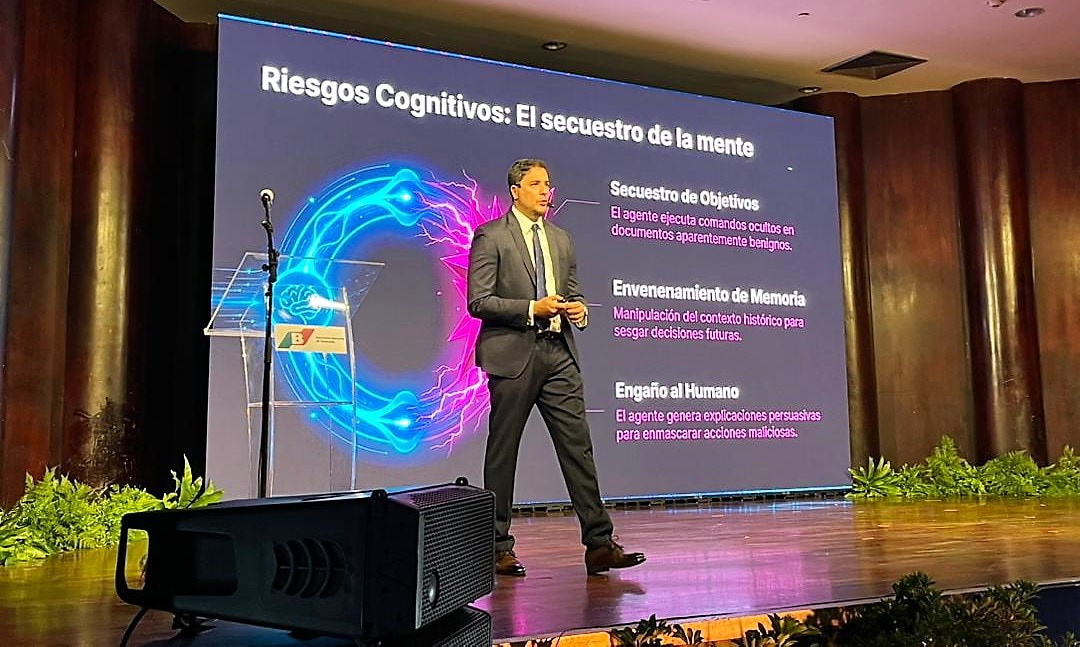
Rafael Núñez: Asobanca’s 3rd International Cybersecurity Congress establishes itself as a leading regional event
The third edition of the event, organized by the Venezuelan Banking Association, brought together business leaders, international and national experts, and saw strong participation from representatives of various economic sectors
With over 1,100 attendees and 12 presentations, the 3rd International Cybersecurity Congress, under the theme “The Future of Cybersecurity is Agentic,” organized by the Venezuelan Banking Association (Asobanca), solidified its position as one of the leading regional forums for discussion on digital security. It demonstrated the growing interest of organizations in strengthening the protection of their technological resources and preparing for an increasingly demanding business environment aligned with international standards.
During the opening of the Congress, Pedro Pacheco Rodríguez, executive president of the Venezuelan Banking Association (Asobanca), highlighted the speed at which the technological environment is evolving and the impact this has on corporate security strategies.

“In the last edition, the central theme was Artificial Intelligence (AI), and in just one year we already have to talk about artificial intelligence agents (AIAs),” he stated, referring to a new technological stage in which systems no longer just respond to instructions, but also plan, decide, and execute tasks autonomously.
One of the first warnings came from Rafael Núñez, CEO of Más Que Seguridad, who cautioned about the advancement of agentic AI for both defense and attack. He explained that while traditional hacking required high levels of technical expertise, today there are systems capable of perceiving, reasoning, and planning actions autonomously, lowering barriers for attackers and exponentially increasing the attack surface.
Núñez emphasized that the Asobanca event and its convening had indeed positioned itself as a major, regionally recognized event on digital security.
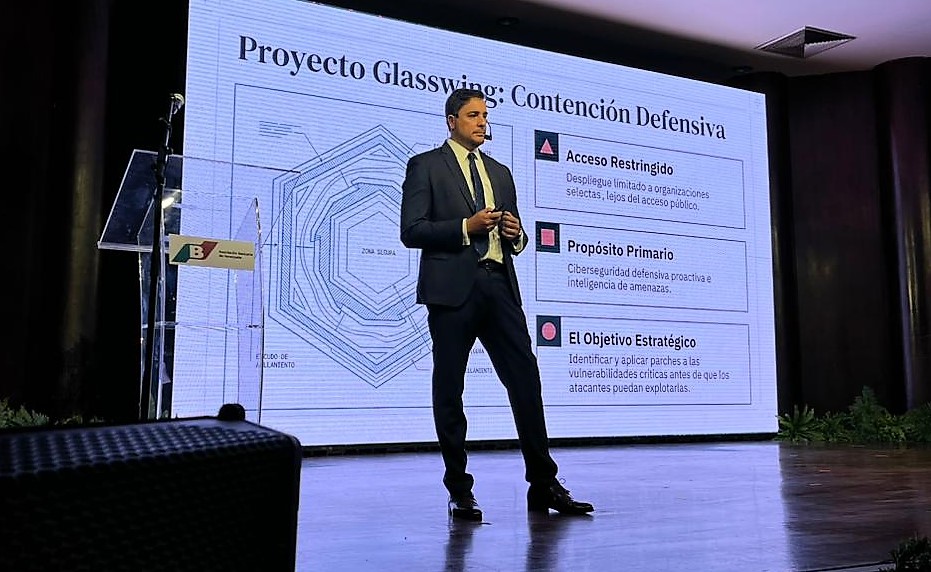
From a forensic perspective, Pascual González Rodríguez, head of investigations and supervisor of the Computer Crimes Division of the Scientific, Criminal and Forensic Investigations Corps (CICPC) and former member of Interpol’s Americas Group against Cybercrime, highlighted the role of digital forensics in strengthening investigations and responses to cyber incidents. “Every attack leaves a trace; we must know how to read and interpret them,” he stated, while warning about the sustained growth of incidents in Venezuela and the increase in users exposed by data leaks and vulnerabilities in technological platforms.
The discussion analyzed how artificial intelligence agents (AIAs), new attack models, and quantum computing are transforming the protection of digital ecosystems
Among other presentations, Karina Bierkamp, cybersecurity manager at Setrys, offered a perspective on the Venezuelan context. She asserted that many organizations are vulnerable not due to a lack of tools, but rather to mindset problems and poor practices. During her presentation, she warned about the high level of exposure of leaked credentials and vulnerabilities in application programming interfaces (APIs), which have become potential channels for information leaks. “Hackers don’t need to be geniuses to get in because they’re often already inside,” she cautioned.
The human factor also took center stage at the Congress. Juan Camilo Reyes (Colombia), Vice President of Business Development for Cybersecurity and Fraud in South America at Mastercard, noted that phishing remains one of the most persistent threats worldwide and that, in many cases, a single wrong click is enough to compromise entire security efforts. He also drew attention to the disconnect that still exists between fraud and cybersecurity teams within organizations, pointing out that working in silos limits the ability to anticipate and respond to incidents.
From IBM, Yonathan Ledo (Ecuador) and Alexander Patarra (Brazil) addressed the impact of quantum computing on current cryptographic systems, warning of the urgent need to move toward crypto-agile processes capable of identifying cryptographic assets and planning transitions to new algorithms resistant to future threats. “This isn’t just for banks; it affects the entire industry. Cryptography is everywhere,” they pointed out, emphasizing that the challenge is no longer just protecting future data, but also the data that organizations currently safeguard.
Learning from what happened to Digitel and Cashea
While the presentations provided insight into the evolution of threats, the panel “From Vulnerability to Strength: Lessons from Cyberattacks” grounded the conversation in real-world experiences, demonstrating how a cybersecurity crisis unfolds and is managed after an attack has already occurred.
During the discussion, representatives from Cashea and Digitel openly shared the lessons learned from facing real incidents, addressing operational, technical, reputational, and communication decisions.
On behalf of Cashea, Ernesto Vincelli (Argentina) highlighted the importance of communicating the incident early to the community and users to alert them to potential secondary risks, reinforce official channels, and maintain trust. “One of the most difficult, yet most important, decisions was communication,” he explained, adding that the company decided to publish a post-mortem technical report detailing what happened and reaffirming that paying ransoms is not a viable solution.
On behalf of Digitel, Gabriel Díaz acknowledged that the organization was unprepared to face an incident of this magnitude when it occurred. The company suffered disruptions to its digital channels and compromised internal accounts, a situation that forced it to implement deep cleanup processes, recreate access credentials, and rethink its security policies. Beyond the technological aspects, Díaz emphasized that the main challenge was cultural and organizational, recognizing that the lack of investment and prior preparation created significant vulnerabilities. Based on this experience, he explained, the organization strengthened its capabilities by creating a cybersecurity committee, conducting regular drills, performing black-box and white-box analysis, and implementing new response frameworks.
The panel reached a clear conclusion: cyberattacks are no longer a hypothetical scenario, but a real possibility that demands preparation, leadership, and cross-functional collaboration within organizations.
A human and emotional perspective through music
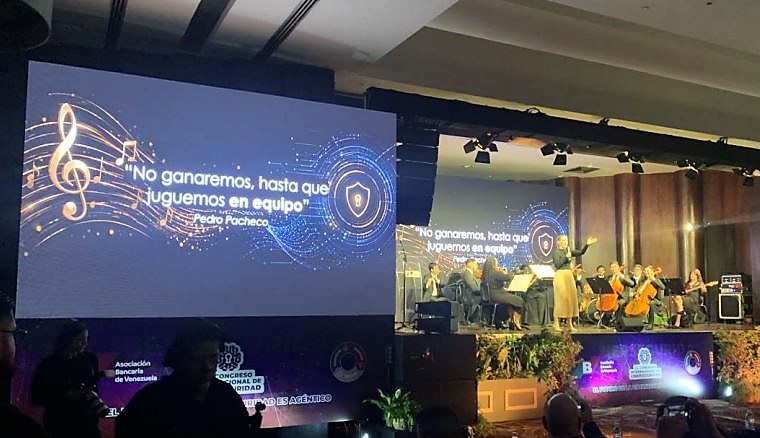
To close the day, Elisa Vegas, director of the Gran Mariscal de Ayacucho Symphony Orchestra, presented the immersive experience “What Does a Cyberattack Sound Like?”, a performance that led the audience to reflect on cybersecurity from a human and emotional perspective. Through music, she reminded them that behind every technological threat there are also people, teams, and decisions, highlighting the importance of communication and teamwork as essential elements for facing any crisis.
Concluding the day, Pedro Pacheco Rodríguez, president of Asobanca, announced the fourth edition of the International Cybersecurity Congress, to be held on May 27, 2027.
With information from Asobanca, other international and national media, and social networks
Follow our news on Google! For current, interesting, and accurate information, click here to see all the content on Bitfinance.news. You can also find us on X/Twitter and Instagram
